Rome and Han China: Two Empires of the Ancient World Compared
Rome and Han China compared: size, government, armies, frontiers, the Silk Road with Parthia in between, contact attempts, and why their fates diverged.
 Open the interactive map
Two empires at the same time
Around the turn of the era, two large states ruled the western and eastern ends of Eurasia. The Han dynasty governed China from 202 BCE to 220 CE, interrupted by Wang Mang's Xin dynasty (9–23 CE), building on the unification achieved by the short-lived Qin in 221 BCE. Rome, a republic that had become a Mediterranean empire, came under the rule of emperors from Augustus in 27 BCE. The historian Walter Scheidel estimates that each controlled roughly four million square kilometres and perhaps sixty million people or more, so that together they ruled a very large share of humanity.
Comparing them is a modern exercise. Neither empire knew the other well, and their records were written for different purposes. But because they faced similar problems, such as governing huge territories with pre-industrial technology, paying armies and managing frontiers, historians have found the comparison useful for seeing what was particular to each.
Government: senators and cities, officials and commanderies
Han China was governed through a salaried bureaucracy. The empire was divided into commanderies and counties run by officials appointed from the capital, Chang'an and later Luoyang, and household registers recorded population for taxes and labour service. A census of 2 CE recorded about 57.7 million people. Under Emperor Wu (141–87 BCE) Confucian teachings gained official favour, and an imperial academy trained candidates for office, although recommendation and family connections remained crucial.
Rome governed with a much thinner layer of officials. Provincial governors were drawn from the senatorial and equestrian elites, and day-to-day administration relied on self-governing cities and their local notables. Roman citizenship spread gradually, through grants and military service, until Caracalla extended it to almost all free inhabitants in 212 CE. Roman law, developed by jurists, became one of the empire's lasting legacies, as did Han administrative practice in East Asia.
Armies and frontiers
Both empires spent much of their income on defence. Han China's main rival was the Xiongnu confederation of the northern steppe. Early Han rulers paid it with silk, grain and marriage alliances; Emperor Wu launched great campaigns against it, extended walls and garrisons into the Gansu corridor and pushed Han influence into the Tarim Basin, the "Western Regions". Later Han general Ban Chao re-established that influence in the late first century CE.
Rome's frontiers ran along the Rhine, the Danube, the Syrian and Arabian deserts and, in Britain, Hadrian's Wall, begun in 122 CE. Its professional army of legions and auxiliaries numbered in the hundreds of thousands. In the east Rome faced an organised empire rather than nomads: Parthian Iran, which defeated Crassus at Carrhae in 53 BCE and fought Rome over Armenia and Mesopotamia for centuries. Both empires also recruited frontier peoples into their armies, with consequences that historians still debate.
Did Rome and Han China know each other?
Only at a distance. Silk reached Rome, where Latin writers called its makers the Seres and moralists such as Pliny the Elder complained about spending on Eastern luxuries. But the trade passed through many hands: Parthian Iran and the Kushan Empire controlled the overland routes, and Indian and Arabian ports linked the sea routes. Chinese envoy Zhang Qian's missions to Central Asia in the second century BCE had opened Han contacts with the west, and Han sources describe Anxi, usually identified with Parthia, as a large kingdom with silver coins and merchants.
Chinese histories call the Roman world Daqin. In 97 CE Ban Chao sent an envoy, Gan Ying, to reach it; he got as far as the sea at the western edge of Parthian territory and turned back, reportedly after local sailors warned him that the voyage could take years. The History of the Later Han records that in 166 CE people claiming to come from the king of Daqin, Andun, arrived by sea at the Han frontier in what is now Vietnam. Andun is often identified with the emperor Marcus Aurelius Antoninus, but most historians think the visitors were merchants rather than an official embassy.
Economy, money and religion
Both economies were overwhelmingly agrarian, and both states taxed peasants to pay soldiers and officials. Their money differed: the Han relied mainly on bronze coins, the wuzhu, and used gold and silk as stores of value, while Rome minted silver and gold coins in large numbers. Han China saw the development of paper, traditionally credited to the court official Cai Lun in 105 CE though earlier examples exist, and state monopolies on salt and iron. Rome excelled in large-scale building with concrete, aqueducts and roads.
Religious change came to both from outside their founding traditions. Buddhism, carried by merchants and monks from India and Central Asia, many of them Parthian, Sogdian and Kushan, reached Han China in the first century CE. In the Roman Empire, Christianity spread from Judaea, alongside cults of Isis and of Mithras, whose links to the Iranian god Mithra are debated by historians.
Endings and the great divergence
The Han dynasty weakened through court factionalism, the power of eunuchs and landed families, and peasant risings such as the Yellow Turban rebellion of 184 CE. Warlords took control, and in 220 the last Han emperor abdicated, opening the period of the Three Kingdoms. The western Roman Empire broke apart in the fifth century, conventionally ending in 476, while its eastern half continued from Constantinople.
The most striking difference came afterwards. China was reunified under the Sui in 589 and the Tang after 618, and empire remained the normal political form there. Western Europe never again came under a single state. Scheidel calls this the "first great divergence" and links it to differences in elites, geography, frontier pressures and ideology; other historians stress chance and the fact that a Roman state survived in the east until 1453. The question remains open, and comparing the two empires is one of the best ways to see that neither path was inevitable.
Frequently asked questions
Did the Roman Empire and Han China ever meet?
Not through official diplomacy that we can confirm. Han envoy Gan Ying set out for the Roman world in 97 CE but turned back at the edge of Parthian territory, and visitors who claimed to represent the king of Daqin reached Han territory by sea in 166 CE, probably as merchants. Goods, especially silk, travelled between them through Parthian, Kushan, Indian and other intermediaries.
Which was bigger, Rome or Han China?
They were broadly comparable. Modern estimates put each at roughly four million square kilometres with populations in the order of fifty to sixty million or more around the turn of the era. The Han census of 2 CE recorded about 57.7 million people; Roman figures are reconstructions and less certain.
What role did Iran play between Rome and China?
A central one. The Parthian Empire controlled the main overland routes between the Mediterranean and Central Asia, profited from the trade and dealt with both powers. Han sources describe Parthia as Anxi, and Parthian and other Iranian-speaking monks and merchants helped bring Buddhism and goods into China.
Why did China reunify but Rome did not?
Historians disagree. Explanations include China's shared written language and bureaucratic elite committed to imperial unity, the geography of the North China Plain compared with the Mediterranean's divided regions, the role of the Church and landed aristocracies in post-Roman Europe, and contingency. Walter Scheidel's comparative work is a good starting point.
Key events on the map
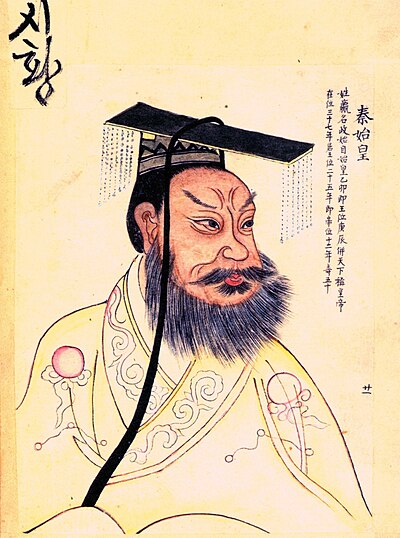
- 221 BCE · Qin Shi Huang Unifies China
- 202 BCE · Han Dynasty — China's Classical Age
- 130 BCE · Silk Road Trade Routes Established
- 120 BCE · Parthians Control the Silk Road
- 53 BCE · Battle of Carrhae (Roman Defeat)
- 27 BCE · Augustus Becomes First Roman Emperor
- 67 CE · Buddhism Enters China
- 105 CE · Invention of Paper in China
- 117 CE · Roman Empire at Greatest Extent Under Trajan
- 122 CE · Hadrian's Wall Built
- 476 CE · Fall of the Western Roman Empire
Guided storylines
- Rome and China: Comparative Perspectives on Ancient World Empires (project outline) — Walter Scheidel, Stanford University
- Han dynasty — Encyclopaedia Britannica
- ancient Rome — Encyclopaedia Britannica
- Silk Road — Encyclopaedia Britannica