Byzantine Empire: History, Timeline & Map (330–1453)
The Byzantine Empire from Constantinople's founding in 330 to its fall in 1453: Justinian, Hagia Sophia, Persia and Islam, icons, Crusaders and Ottomans.
 Open the interactive map
The Roman Empire in the east
"Byzantine Empire" is a label that Western scholars began to use in the sixteenth century. Its people called themselves Romans (Rhomaioi) and their state the Roman Empire, governed from Constantinople, the city Constantine dedicated in 330 on the site of the Greek colony of Byzantion. It was Greek-speaking, Orthodox Christian and continuous with Rome in law and institutions. Historians usually begin a distinct Byzantine history somewhere between 330 and the seventh century; the choice is a convention, not an event.
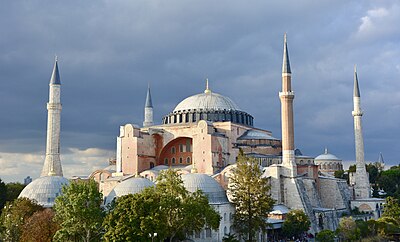
Justinian I (527–565) codified Roman law, survived the Nika riots of 532 with the help of Empress Theodora, built Hagia Sophia (completed 537) and reconquered North Africa and Italy, but plague from 541 and long wars strained the state. The war of 602–628 with Sasanian Iran ended in Heraclius' victory, yet within a decade the Arab conquests took Syria, Palestine and Egypt from the empire.
Icons, Rus', Crusaders and the fall of Constantinople
Reduced to Anatolia, the Balkans and parts of Italy, the empire held Constantinople against Arab sieges, using "Greek fire" among other means, and argued bitterly over religious images in the Iconoclast controversy (c. 730–787 and 815–843). Its missionaries and diplomats carried Orthodox Christianity to the Slavs: Cyril and Methodius in 863, and the baptism of Kyivan Rus' around 988. Under Basil II (976–1025) it was again a leading power in the eastern Mediterranean.
The mutual excommunications of 1054 marked a growing split with the Latin Church, and the Seljuk victory at Manzikert in 1071 opened Anatolia to Turkish settlement. The Fourth Crusade sacked Constantinople in 1204; the Byzantines retook it in 1261, but the restored state was small. The Ottoman sultan Mehmed II captured the city in 1453. Byzantine law, Orthodox Christianity and the Greek manuscripts its scholars preserved shaped Russia, the Balkans, the Islamic world and Renaissance Italy.
Timeline of events
330 CE · Constantinople Founded
Emperor Constantine I dedicates Constantinople (modern Istanbul) as the new capital of the Roman Empire, shifting power eastward. (Constantinople) View on map
532 CE · Empress Theodora and the Nika Riots
In January 532 the Blue and Green chariot-racing factions of Constantinople joined in revolt against Justinian I, chanting 'Nika!' ('Conquer!'), burned much of the city centre and proclaimed a rival emperor. According to the historian Procopius, Justinian was ready to flee until the empress Theodora, a former actress, declared she would rather die in the imperial purple; the speech may be partly Procopius' own composition. Troops under Belisarius and Mundus then trapped the crowd in the Hippodrome and killed, by Procopius' figure, some 30,000 people; weeks later Justinian began rebuilding the burned Hagia Sophia. (Hippodrome, Constantinople) View on map
534 CE · Justinian's Code of Laws
Emperor Justinian codifies Roman law into the Corpus Juris Civilis, which becomes the foundation of civil law in much of Europe. (Constantinople) View on map
537 CE · Hagia Sophia Completed
Emperor Justinian completes the Hagia Sophia in Constantinople, the world's largest cathedral for nearly a thousand years. (Constantinople) View on map
678 CE · Greek Fire Defends Constantinople
The Byzantines use Greek fire, a devastating incendiary weapon, to repel the Arab siege of Constantinople, saving the empire. (Constantinople) View on map
726 CE · Byzantine Iconoclasm Controversy
From the reign of Leo III, traditionally from 726 or 730, Byzantine emperors and church councils restricted or banned the veneration of religious images (icons), a policy pressed hardest by Constantine V, whose council of 754 condemned them. The Second Council of Nicaea restored icons in 787, a second iconoclast period began in 815, and the empress-regent Theodora ended it in 843, a restoration the Orthodox Church still celebrates as the Triumph of Orthodoxy. Almost all surviving sources were written by the victorious supporters of icons, and recent scholarship (Brubaker and Haldon) argues that Leo III's own measures were limited and later exaggerated. (Constantinople) View on map
863 CE · Cyril and Methodius Mission to Moravia
In 863, answering a request from Prince Rastislav of Great Moravia, the Byzantine emperor Michael III sent the brothers Constantine (later called Cyril) and Methodius of Thessalonica to teach Christianity in the Slavs' own language. Constantine devised the Glagolitic alphabet, and the brothers translated the Gospels and liturgy into the language now called Old Church Slavonic, a practice the pope approved in Rome in 867–868 despite opposition from Frankish clergy. After Methodius died in 885 their disciples were expelled from Moravia and carried the work to Bulgaria, where the Cyrillic script was developed; the exact centre of Great Moravia, possibly Mikulčice, is uncertain. (Great Moravia (Mikulčice, approx.)) View on map
1054 CE · East–West Schism: The Excommunications of 1054
On 16 July 1054 papal legates led by Cardinal Humbert laid a bull excommunicating Patriarch Michael Keroularios (Cerularius) on the altar of Hagia Sophia in Constantinople, and a synod under the patriarch condemned the legates in turn. The quarrel was over papal authority, the filioque clause of the Creed and the use of unleavened bread, and the legates' standing was doubtful, since Pope Leo IX had died in April. Historians see the split between the Latin and Greek churches as a slow process rather than a single break: the crusader sack of Constantinople in 1204 hardened it, and the mutual excommunications were lifted only in 1965. (Hagia Sophia, Constantinople) View on map
1071 CE · Battle of Manzikert
The Seljuk Turks decisively defeat the Byzantine Empire at Manzikert, opening Anatolia to Turkish settlement and leading to the Crusades. (Manzikert (Malazgirt)) View on map
Frequently asked questions
Did the Byzantines call themselves Byzantine?
No. They called themselves Romans and their state the Roman Empire. "Byzantine", from Byzantion, the old Greek name of Constantinople, became common among Western scholars from the sixteenth century onward. Their neighbours, including Persians, Arabs and Turks, also called them Romans (Rum).
Why did Constantinople fall in 1453?
By 1453 the empire held little more than the city and parts of the Peloponnese, weakened by the sack of 1204, civil wars and Ottoman expansion in the Balkans and Anatolia. Mehmed II besieged it with a much larger army and heavy cannon, and help from Latin Europe was limited.
Key events on the map
- 330 CE · Constantinople Founded
- 532 CE · Empress Theodora and the Nika Riots
- 534 CE · Justinian's Code of Laws
- 537 CE · Hagia Sophia Completed
- 726 CE · Byzantine Iconoclasm Controversy
- 988 CE · Vladimir I and the Christianisation of Kyivan Rus'
- 1054 CE · East–West Schism: The Excommunications of 1054
- 1071 CE · Battle of Manzikert
- 1204 CE · Fourth Crusade Sacks Constantinople
Guided storylines
- Byzantine Empire — Encyclopaedia Britannica
- Byzantine Philosophy — Stanford Encyclopedia of Philosophy
- Fall of Constantinople — Encyclopaedia Britannica